
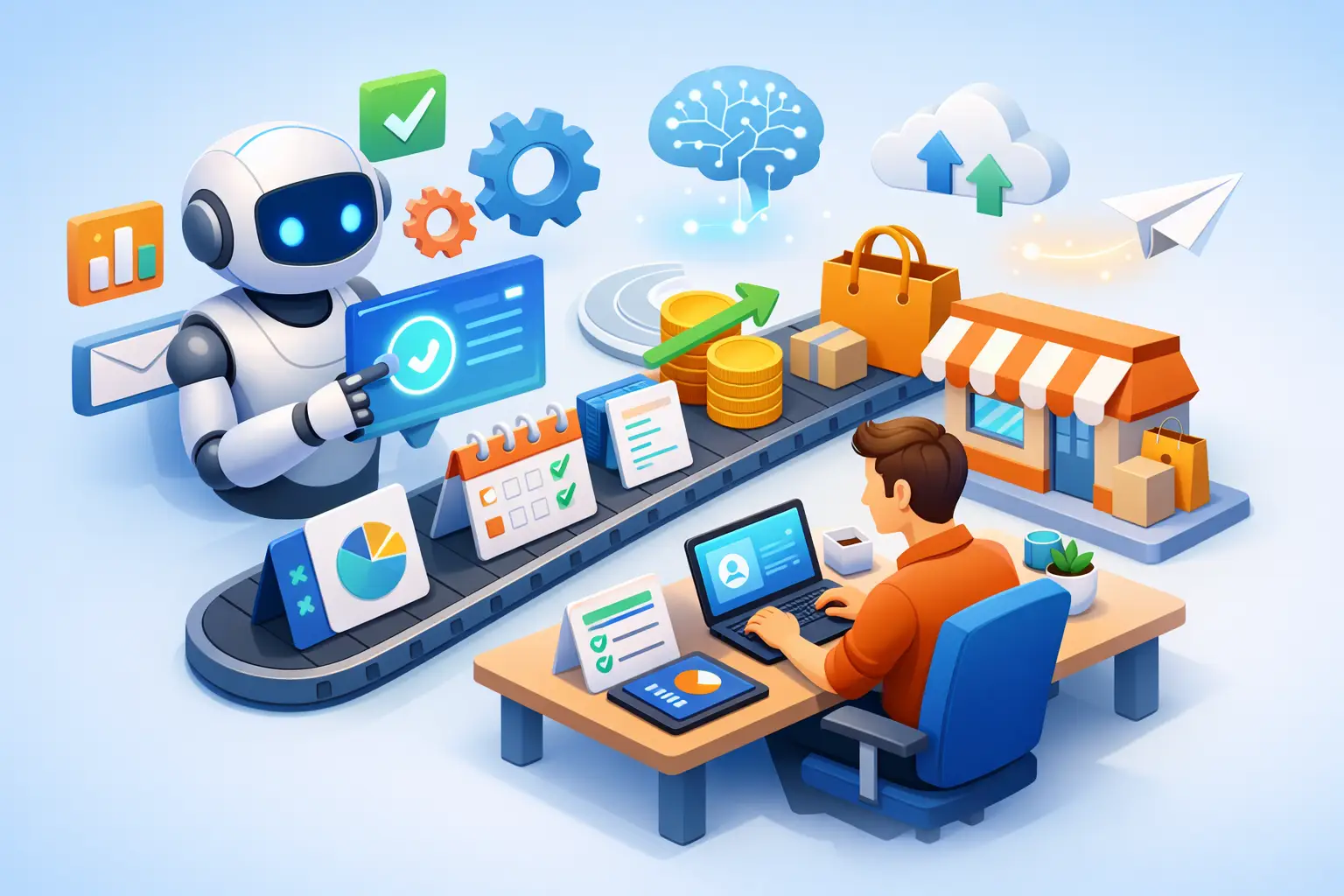
Most small business owners do not need more software. They need fewer repeat decisions, fewer dropped follow-ups, and fewer hours lost to tasks that should have been handled once and turned into a system. That is where ai automation for small business tasks starts to make real sense – not as a trend, but as a way to reduce manual work that keeps pulling attention away from sales, service, and growth.
The mistake is thinking AI automation means rebuilding your entire business around complicated tools. In practice, the best results usually come from automating small, annoying, high-frequency tasks first. If you answer similar emails every week, rewrite the same social captions, summarize the same client notes, or manually sort leads from forms, you already have good automation candidates.
What AI automation for small business tasks actually means
For a small business, AI automation usually combines two things. First, AI handles language, summarization, categorization, drafting, or pattern recognition. Second, automation moves information from one place to another without manual copying and pasting.
That might look like a contact form submission being analyzed, tagged by lead type, added to your CRM, and followed by a draft reply. Or it might mean a recorded meeting gets transcribed, summarized, and turned into action items. The goal is not to remove judgment from the business. The goal is to stop spending human energy on work that follows the same pattern every time.
That distinction matters. AI is helpful when the task is repetitive but still benefits from flexible language or interpretation. Standard automation handles fixed logic well. AI becomes useful when the input changes but the outcome stays similar.
Where small businesses get the fastest wins
The fastest wins usually show up in communication, content, admin, and lead handling because those are packed with repeatable micro-tasks.
If you run a service business, email is often the first place to look. AI can draft replies to common questions, summarize long email threads, and suggest next steps based on the message history. You still review before sending, but the blank-page problem disappears.
Marketing is another strong use case. Small teams spend too much time turning one idea into five assets. A single webinar, blog post, or offer page can be repurposed into email drafts, social posts, ad variations, and short summaries. That does not mean every output is publish-ready. It means your first draft is created in minutes instead of starting from scratch each time.
Admin work is full of hidden automation opportunities. Invoice reminders, intake form sorting, appointment follow-ups, proposal formatting, and meeting notes are all tasks that can be standardized. If a task happens often and follows a recognizable structure, it is worth reviewing.
Lead management is where many businesses lose money quietly. New leads arrive, sit too long, get tagged inconsistently, or never receive the right follow-up. AI can help classify inquiries, identify intent, suggest responses, and route prospects based on urgency or service type. That is useful because speed and consistency often matter more than sophistication.
The best way to start AI automation for small business tasks
The wrong way to start is with tools. The right way is with friction.
Pick one process that creates repeat work every week. Map it in plain English. What triggers it? What information comes in? What decision gets made? What output gets sent or saved? If you cannot explain the process clearly, automation will only make the mess happen faster.
A simple filter helps here. Start with tasks that are high-frequency, low-risk, and text-heavy. Those are usually the easiest to automate well. Think customer inquiry routing, meeting summaries, content repurposing, FAQ drafting, and internal note organization.
Avoid high-risk processes at the beginning. If an error would affect legal compliance, payroll, contracts, or financial reporting, keep a much tighter approval layer. AI is useful, but it is still not something you should trust blindly with sensitive business decisions.
A practical setup that works for lean teams
Most small businesses do not need a custom-built system on day one. A practical setup often includes four parts: a trigger, an AI step, an action step, and a review step.
A trigger might be a new form submission, a received email, a booked call, or an uploaded file. The AI step analyzes or generates something based on that input. The action step sends, saves, tags, or routes the result. The review step gives a person a chance to approve or spot-check important outputs.
For example, a freelance consultant might use this flow: a prospect fills out a form, the response is summarized by AI, the lead is tagged by project type and budget range, a draft reply is generated, and the consultant reviews it before sending. That is a strong workflow because it speeds up the process without removing control.
This is also where prompt quality matters. Vague instructions create vague outputs. Clear prompts that specify format, audience, tone, constraints, and desired action produce better results. If your business depends on consistency, treat prompts like operating procedures, not casual requests.
Trade-offs you should expect
AI automation can save time, but it also creates new responsibilities.
The first trade-off is setup time. Even simple workflows take testing. You will need to refine prompts, catch edge cases, and adjust the logic when something gets misclassified or drafted poorly. The payoff is real, but it is not instant magic.
The second trade-off is accuracy versus speed. Faster output is only valuable if it is usable. For internal summaries, a small error may not matter much. For client-facing communication or pricing details, the review process matters a lot more.
The third trade-off is voice consistency. AI can help generate content quickly, but if your inputs are generic, the outputs will sound generic too. Small businesses often compete on trust and clarity, so your brand voice still needs human direction.
There is also a tool overload risk. Many owners stack multiple apps before they know what problem they are solving. That usually creates a more fragile system. Fewer tools, clearer workflows, and stronger documentation tend to perform better than complicated setups that no one maintains.
Common mistakes that waste time
One common mistake is trying to automate a broken process. If your intake form asks bad questions or your sales pipeline is disorganized, AI will not fix the underlying issue. It will just speed up confusion.
Another mistake is over-automating customer interactions. Some communication should stay personal, especially when trust, nuance, or problem-solving is involved. If every message sounds templated, the business may become more efficient while feeling less credible.
Many businesses also skip measurement. If you do not know how long a task took before automation, you cannot tell whether the workflow is helping. Track a few simple numbers: time saved, response time, lead follow-up rate, content output, or error reduction. You do not need enterprise analytics. You need enough visibility to know what is working.
How to decide what should stay human
A good rule is simple: the more risk, emotion, or strategic judgment involved, the more human oversight the task needs.
AI is excellent for first drafts, summaries, sorting, extraction, and formatting. It is less reliable when the task depends on context that lives only in your head, subtle relationship management, or decisions with financial and legal consequences.
That means a smart business does not ask AI to run the company. It asks AI to reduce drag. The owner, operator, or team still makes the important calls. The system just clears away the repetitive work around those decisions.
Building systems that last
The businesses that benefit most from AI automation are not always the most technical. They are usually the ones that document what they do, keep workflows simple, and improve them over time.
If you want this to stick, create a basic process library as you build. Write down the trigger, the tool stack, the prompt, the output, and the review standard. That makes it easier to fix problems, train help later, and avoid rebuilding the same workflow from memory.
This is also why practical education matters. Small business owners do not need abstract AI theory. They need training they can actually use, whether that comes from internal documentation, tested prompts, or implementation-focused resources like those shared at paul.crumblelibrary.com. The value is not in knowing what AI could do. It is in putting a few dependable systems to work this week.
If you start small, choose the right tasks, and keep a human review where it counts, AI automation becomes less about hype and more about breathing room. And for most small businesses, breathing room is where better decisions finally have a chance to happen.













0 Comments