
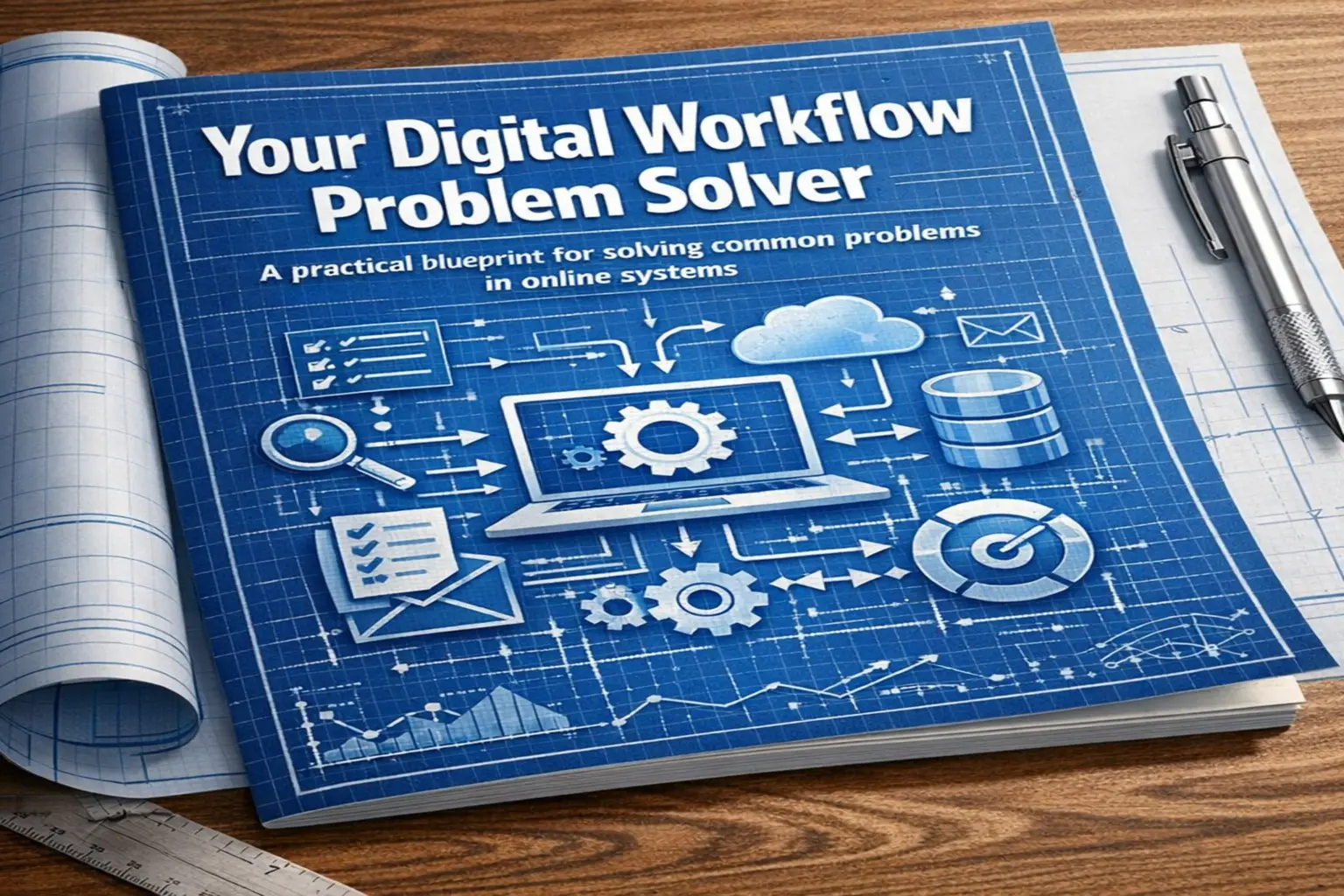
Systems Over Hype: A Review of the Digital Workflow Problem Solver
If you have spent any time in the world of online marketing or digital creation, you’ve likely experienced “Tool Fatigue.” It’s that nagging feeling that you are one software subscription away from finally “arriving”—only to find that adding a new tool to your belt just adds another login, another monthly bill, and another learning curve.
Download for FREE Paul Crumble’s “Your Digital Workflow Problem Solver.”
This isn’t your typical “Top 10 Tools for 2026” listicle. It doesn’t promise “one weird trick” to double your traffic. Instead, it offers something much rarer: a structural blueprint for how digital work actually functions.
I’ve spent several days dissecting the 10-chapter framework provided in this document. Below is a comprehensive review of its philosophy, its practical utility, and whether it deserves a place in your digital library.
The Core Philosophy: “Infrastructure, Not Strategy”
The most striking aspect of this blueprint is its foreword. Crumble immediately challenges the reader to stop looking for “better software” and start looking for “better structures.”
The central thesis is that a tool is simply infrastructure. Much like a hammer doesn’t build a house without a blueprint, a social media scheduler won’t build a brand without a visibility system. The guide argues that successful systems are built around recurring functions:
- Creating Content
- Gaining Visibility
- Organizing Access
- Maintaining Communication
- Building Credibility
- Improving Performance
My Take: This shift from tactical (using a tool) to structural (building a system) is the most valuable part of the document. It moves the reader from being a “consumer of software” to being an “architect of systems.”
The 10-Problem Framework: A Deep Dive
The document is organized into ten chapters, each addressing a specific “operational challenge.” Here is a breakdown of how the blueprint tackles the most critical parts of the digital workflow.
1. The Discovery and Content Layer (Chapters 1-3)
The blueprint starts where most projects fail: getting seen and staying consistent.
- Visibility: It correctly identifies that “post and pray” is not a strategy. By highlighting content intelligence, it forces the reader to confront the reality of search demand.
- Visual Efficiency: The guide recognizes that design friction is a major bottleneck. It doesn’t tell you to become a pro designer; it tells you to find a system that makes “professional-enough” visuals fast.
- Repurposing: This chapter is particularly timely. In an era of short-form video dominance, the blueprint suggests using AI not to replace creativity, but to scale it.
2. The Distribution and Navigation Layer (Chapters 4-5)
This section deals with the “logistics” of digital work.
- Publishing Consistency: The review of this section found it refreshingly honest—consistency isn’t about being “on” all the time; it’s about having a schedule that runs when you aren’t.
- The Navigation Bottleneck: Many people overlook the “one link” problem on social media. The blueprint treats this as a structural navigation issue, which is a clever way to frame it.
3. The Relationship and Conversion Layer (Chapters 6-8)
This is the “engine room” of the system.
- Communication: The focus here is on automation and segmentation. The guide argues that as you scale, manual engagement is a liability.
- Integration: This is perhaps the most important chapter for beginners. Crumble warns against the “Franken-stack”—a collection of disconnected tools—and advocates for integrated platforms that reduce “technical friction.”
- Acquisition: While some might find lead acquisition systems controversial, the blueprint frames it as a necessary input for any communication system.
4. The Trust and Optimization Layer (Chapters 9-10)
Finally, the guide looks at the “intangibles” and the “future.”
- Social Proof: It correctly identifies that in a digital-first world, trust is a currency. Aggregating reviews isn’t just a “nice to have”; it’s a conversion necessity.
- Speed of Iteration: The final chapter looks at how AI can shorten the feedback loop. The faster you can test a headline or a funnel step, the faster you grow.
Analysis of Tool Selection
A common pitfall of these types of documents is that they become “shills” for specific software. However, Crumble avoids this by labeling every tool as a “practical example” rather than a definitive recommendation.
The tools chosen (Buffer, Canva, systeme.io, etc.) are generally:
- Accessible: Most have free tiers or low entry costs.
- Reliable: These are established players in the market, not “here today, gone tomorrow” startups.
- Low Friction: They are designed for individual creators, not enterprise-level IT teams.
By using these as “models” for their respective categories, the blueprint remains useful even if you choose a direct competitor (e.g., using Mailchimp instead of GetResponse).
Strengths: What This Blueprint Does Well
- Clarity of Structure: Each chapter follows a repeatable format: Problem → Why it Matters → Type of Solution → Example. This makes it incredibly easy to scan and use as a reference.
- Neutrality: It doesn’t feel like a sales pitch. It feels like a map.
- Timelessness: Because it focuses on problems (which stay the same) rather than just tools (which change), this document will likely still be relevant in three years.
- The “Why”: Most tutorials tell you how to use a tool. This blueprint tells you why you need that category of tool in the first place.
Weaknesses: What to Watch Out For
- Broad vs. Deep: This is a high-level architectural overview. If you are looking for a step-by-step tutorial on how to set up an email automation in GetResponse, you won’t find it here. You’ll need to look for specific documentation for that.
- Individual Focused: The blueprint is clearly aimed at solopreneurs, creators, and small digital teams. Larger organizations with complex, custom-coded backends might find the “integrated platform” advice (like systeme.io) too simplistic for their needs.
Who Should Read This?
1. The Overwhelmed Creator:
If you have 15 tabs open and feel like you are spinning your wheels, this will help you prioritize your “infrastructure” and ignore the noise.
2. The New Digital Marketer:
This is an excellent “Day 1” manual to understand how all the pieces (content, leads, trust, funnels) fit together.
3. The Agency Owner:
Use this as a framework to explain to clients why they need more than just “a website” to succeed.
Final Verdict
The “Your Digital Workflow Problem Solver” is a sobering, much-needed reset for anyone working in the online space. It cuts through the hype of the “next big thing” and refocuses the reader on the fundamental mechanics of a digital business.
It is less of a “how-to guide” and more of a “how-to-think guide.” By the end of the 23-page PDF, you realize that your problem probably isn’t that you have the “wrong” tool—it’s that you don’t have a clear role for the tools you already own.
If you are ready to stop collecting software and start building a system that actually works for you, this blueprint is a must-read.














0 Comments