
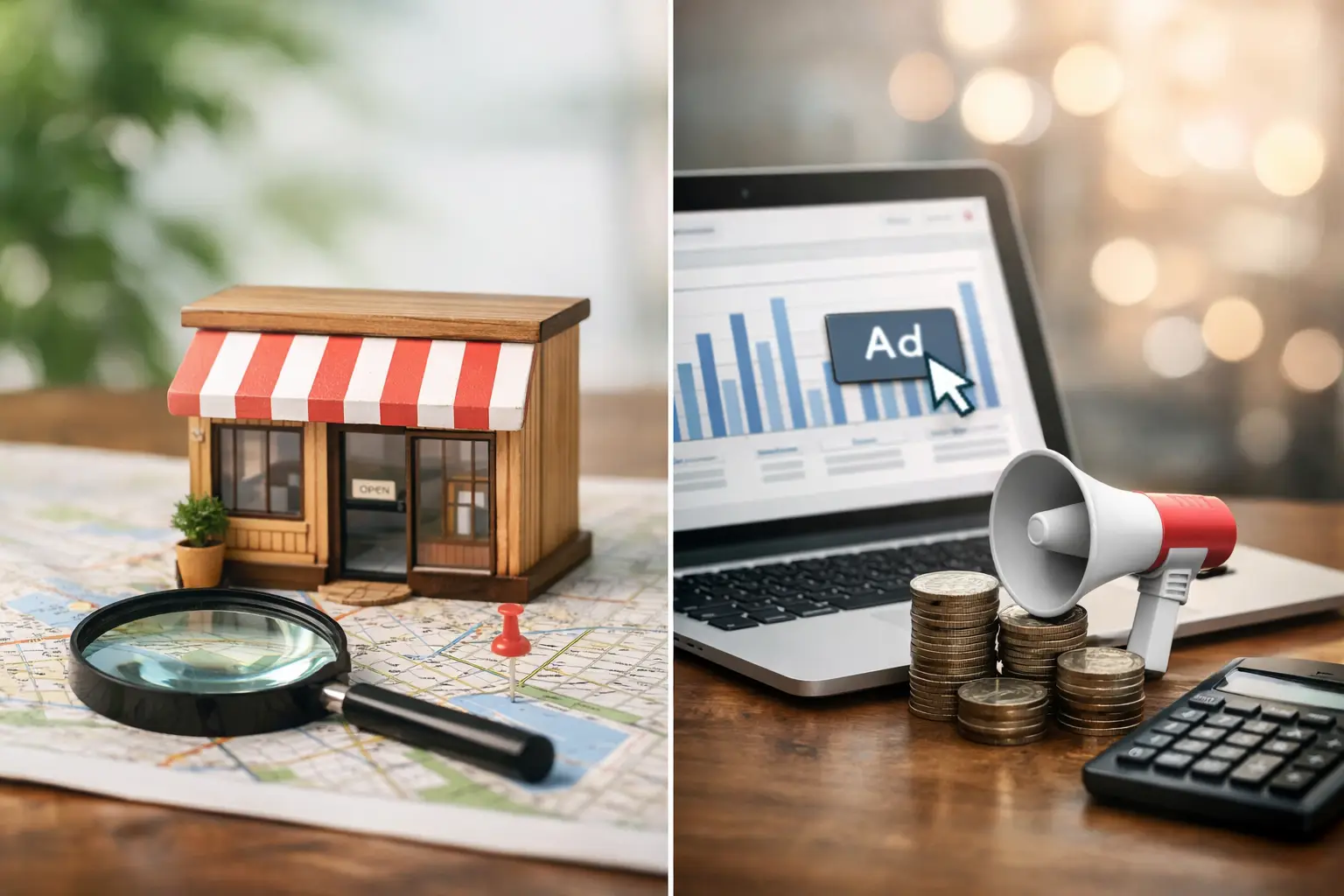
If your phone needs to ring this month, ads look tempting. If you want leads to keep coming six months from now without paying for every click, local SEO starts to look a lot better. That is the real tension in local SEO vs ads – short-term speed versus long-term compounding.
For small business owners, freelancers, and lean marketing teams, this is not a theory question. It is a budget question. It is a time question. And in many cases, it is the difference between building a repeatable lead system and constantly starting over.
Local SEO vs Ads: the real difference
Local SEO helps your business show up when people search for services in a specific area. That usually means your Google Business Profile, local map results, location pages, reviews, citations, and on-site content all work together to improve visibility.
Ads, in this context, usually mean paid search ads on Google, local service ads where available, and sometimes paid social campaigns targeted by geography. You pay to appear in front of potential customers now.
The big difference is not just traffic source. It is how each channel behaves over time.
With ads, visibility can start fast, but it stops when spending stops. With local SEO, results usually take longer, but the return can improve month after month if the work is done well. One is rented attention. The other is built equity.
That does not mean one is always better. It means each one solves a different problem.
When local SEO makes more sense
Local SEO is usually the stronger play when your business depends on nearby intent and repeat visibility. Think home services, dental practices, law firms, salons, repair shops, local consultants, photographers, gyms, and similar service businesses.
If people are already searching for what you do in your city, local SEO gives you a chance to appear in the map pack and organic results without paying for every visit. That matters because local buyers often make decisions fast. They compare ratings, proximity, hours, and trust signals before they ever reach your website.
The biggest advantage is durability. A well-optimized profile with strong reviews, accurate business information, relevant service pages, and consistent local signals can keep generating leads long after the initial work is done.
It also tends to improve lead quality. Someone searching “emergency plumber near me” or “best accountant in Austin” is already showing clear intent. If your local presence is strong, you are meeting them at the right moment.
The trade-off is patience. Local SEO usually takes time. In a competitive city or category, it can take months to improve rankings and trust signals. If your profile is weak, your website is thin, or your reviews are inconsistent, progress will not happen overnight.
When ads are the better tool
Ads are usually the right move when speed matters more than staying power.
If you just launched, need leads quickly, are testing a new offer, or want coverage in a market where your SEO presence is weak, ads can create immediate visibility. That is especially useful for seasonal businesses, limited-time promotions, or service providers entering a new area.
Ads also give you sharper control. You can choose keywords, set geographic boundaries, write tailored messaging, and direct traffic to specific landing pages. That makes paid traffic useful for testing demand before you invest heavily in long-term SEO work.
There is another practical benefit. Ads produce data faster. You can learn which services get clicks, which headlines convert, and which locations perform best. That insight can improve your broader marketing strategy, including what you later build into your SEO pages.
The downside is simple. Paid traffic gets expensive fast, especially in competitive categories like legal, finance, real estate, and home services. If your conversion tracking is weak or your landing pages are underperforming, ad spend disappears without much to show for it.
Cost is not as simple as cheap vs expensive
A lot of business owners assume SEO is free and ads are expensive. That is not really true.
Local SEO may not charge you per click, but it still costs time, expertise, and often content, website, and review management work. If you do it yourself, the cost is time you are not spending elsewhere. If you outsource it, the cost is ongoing service fees or project-based work.
Ads are more visible as a cost because they hit your budget directly. But they can still be efficient if your numbers make sense. If you spend $500 to generate $3,000 in profitable work, that is not expensive. If you spend $500 to get low-quality leads that never close, it is.
A smarter way to think about local SEO vs ads is this: ads usually have a clearer short-term cost, while SEO usually has a slower but more compounding return. Your decision should come from cash flow, timeline, and margin.
How local SEO and ads affect trust
This part gets overlooked.
Many local customers do not click the first thing they see. They scan. They compare. They check reviews, business details, and whether your brand feels established. Local SEO supports that behavior better because it builds your full presence, not just your placement.
A strong Google Business Profile, accurate contact details, quality reviews, service area relevance, and helpful location content all create trust before the lead form is filled out.
Ads can still support trust, but only if they lead somewhere credible. If your ad copy is strong but your landing page is weak, generic, or thin on proof, performance drops. Paid visibility can get attention. It does not automatically earn confidence.
That is why businesses with poor websites often blame ads when the real issue is post-click experience.
Local SEO vs ads for different business stages
If you are brand new, ads can help you get early traction while your local SEO foundation is still being built. At that stage, waiting only on SEO may slow growth too much.
If you are established but overly dependent on referrals, local SEO is often the better investment. It helps create a more predictable acquisition channel and reduces reliance on word-of-mouth alone.
If your business already ranks well locally but you want to push a specific service, promotion, or neighborhood, ads can fill that gap. They are also useful when competitors dominate paid placements and you need more share of screen.
If your budget is tight, your best move may not be choosing one forever. It may be sequencing them correctly.
The smartest approach is usually both, but not equally
Most small businesses do not need a philosophical answer. They need a working allocation.
A practical setup often looks like this: use ads for immediate lead generation and testing, while building local SEO assets in the background. Over time, as your rankings, reviews, and local content improve, you reduce pressure on paid traffic or use it more selectively.
That creates balance. Ads handle urgency. SEO builds resilience.
What you do not want is to rely only on ads forever if your category has strong local search intent. That creates a treadmill effect. Every month starts at zero. On the other hand, relying only on SEO when you need leads right now can create a painful gap.
The right mix depends on your timeline, margins, market competition, and internal capacity to manage campaigns well.
How to decide what to prioritize first
Start with three questions.
How fast do you need results? If the answer is immediately, ads probably need to be part of the plan.
How strong is your current local presence? If your Google Business Profile is incomplete, your reviews are thin, and your website has no useful local pages, local SEO likely has major upside.
How confident are you in conversion? If you have a strong website, clear offer, solid reviews, and good follow-up, ads become much safer to fund because traffic is more likely to turn into revenue.
If you are unsure, audit the basics before spending heavily on either channel. Make sure your profile is claimed, contact information is consistent, service pages are clear, and conversion tracking exists. Better inputs lead to better performance in both SEO and paid campaigns.
This is also where structured, practical training helps. Businesses that learn how to evaluate channels properly make better decisions than those bouncing between tactics. That is the difference between collecting marketing ideas and applying what you learn.
What wins in the long run?
If you are asking about long-term efficiency, local SEO usually wins. It builds an asset that can keep producing leads without paying for each click. For many local businesses, that becomes the more stable and defensible channel over time.
If you are asking what works fastest, ads win. They can put your offer in front of buyers this week.
So the better question is not which one is best. It is which problem are you solving first.
If your business needs momentum, use ads with discipline. If your business needs durability, invest in local SEO with consistency. If you need both, build the system in layers and let each channel do the job it is best at.
A good marketing decision is not the one that sounds smartest. It is the one you can execute well, measure clearly, and keep improving without wasting another quarter guessing.











0 Comments