
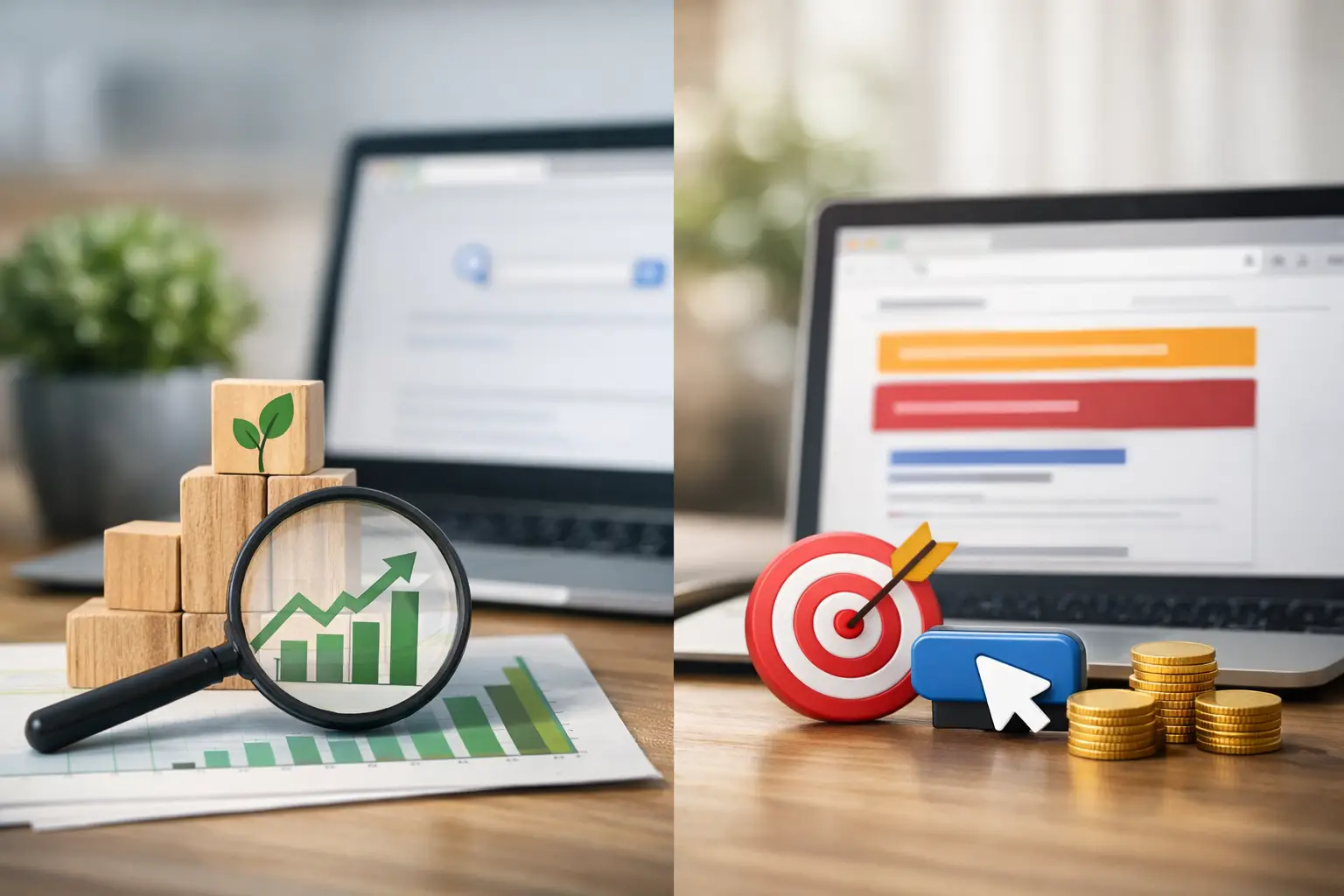
A local service business can spend $1,500 on Google Ads this month and see calls tomorrow. That same business might publish useful pages for six months before SEO produces meaningful leads. This is why the SEO vs Google Ads decision is not really about picking a winner. It is about choosing the right tool for your cash flow, timeline, offer, and ability to follow through.
For small businesses and independent marketers, the costly mistake is treating either channel as automatic. Ads can produce fast data and fast leads, but they stop when the budget stops. SEO can become a durable source of traffic, but it requires consistent work before it earns trust and rankings. The strongest choice depends on what your business needs next.
SEO vs Google Ads: The Core Difference
SEO, or search engine optimization, is the work of improving your website so it can appear in unpaid Google search results. That may include creating useful service pages, improving local listings, answering customer questions, earning credible mentions, and making your site technically easy to use.
Google Ads places your business in paid search results. You choose keywords, set a budget, write ads, and pay when someone clicks. You can target searches such as “emergency plumber near me” or “bookkeeping services for freelancers” and begin collecting data almost immediately.
The practical difference is ownership. With SEO, you are building an asset on your website that can keep generating visits after the original work is done. With Google Ads, you are renting visibility in an auction. Both can be profitable. Neither is free.
SEO costs time, expertise, content, technical improvements, and often outside help. Ads require media spend, landing pages, tracking, ongoing optimization, and enough margin to absorb clicks that do not convert. Looking only at whether traffic is paid or unpaid hides the real investment.
When Google Ads Is the Better First Move
Google Ads makes sense when speed matters. If you have a new offer, a seasonal promotion, open appointment capacity, or a launch deadline, paid search can put you in front of people actively looking for a solution now.
It is also useful when you need evidence before making a bigger marketing investment. A focused campaign can show whether people search for your offer, which terms bring qualified visitors, what objections appear in your calls, and whether your landing page converts. That information can improve your SEO plan later.
For example, a freelance web designer may be unsure whether to position a new package around “WordPress maintenance,” “website support,” or “small business website updates.” Running small, tightly structured campaigns can reveal which language attracts the right clients. The goal is not to buy every click forever. It is to make a smarter decision with real market feedback.
Google Ads works best when the foundation is already in place: a clear offer, a page built around one action, reliable conversion tracking, and a process for responding quickly to leads. Sending paid traffic to a generic homepage is often an expensive way to learn that your message is unclear.
Ads are less attractive when click costs are high, profit per customer is low, or the business cannot track calls, forms, and booked work. If you cannot tell which keywords create revenue, optimization becomes guesswork. Start smaller than you think, measure actual outcomes, and cut what does not produce qualified demand.
When SEO Is the Better Investment
SEO is usually the better long-term move when customers repeatedly search for the services, products, or answers you provide. It is especially valuable for local businesses, consultants with specialized expertise, ecommerce stores with clear product categories, and service providers whose prospects research before buying.
A useful SEO strategy does not begin with publishing random blog posts. It begins with commercial intent. Build and improve the pages that help someone choose you: core service pages, location pages where appropriate, product category pages, comparison pages, case studies, and clear answers to high-value questions.
A tax professional, for instance, may get more business value from a strong page about small-business tax preparation in their service area than from five broad articles about personal finance. A marketing consultant may benefit from a page explaining their audit process, who it is for, and what clients receive. Search visibility improves when the page genuinely matches the searcher’s job to be done.
SEO is not a quick fix for a weak website or an unclear offer. Results can take months, particularly in competitive markets. Search rankings also change as competitors improve their sites and Google adjusts its systems. Still, every useful page, customer review, technical fix, and credible piece of content can compound over time.
Choose SEO first when you can commit to steady implementation and do not need every lead to arrive next week. It is a better fit for businesses building a durable marketing system rather than chasing short bursts of attention.
Compare Cost by Customer Value, Not by Click Price
A $12 click can be a bargain or a disaster. The answer depends on what happens after the click.
If a consultant pays $300 to generate a discovery call and closes one $5,000 project from every five calls, the economics may work well. If a low-margin retailer pays $1,000 for traffic that produces $900 in gross profit before product, shipping, and labor costs, the campaign is losing money even if the dashboard reports plenty of conversions.
Use a simple calculation before increasing spend:
Allowable cost per lead = average profit per new customer x lead-to-customer close rate.
If your average profit from a new customer is $1,200 and you close 20% of qualified leads, your rough allowable cost per qualified lead is $240. That number gives you a decision point. It does not excuse poor follow-up, but it stops you from judging campaigns by clicks alone.
Apply the same thinking to SEO. Estimate what a page could be worth if it brings several qualified leads each month over a year. The return is often slower to appear, but it may continue long after the initial content and optimization costs are paid.
The Best Answer Is Often Both, With Different Jobs
Many businesses benefit from using SEO and Google Ads together, but not by duplicating effort without a plan. Assign each channel a job.
Use Google Ads for immediate demand, testing high-intent keywords, promoting time-sensitive offers, and covering gaps while your organic visibility grows. Use SEO to build pages around proven demand, capture research-stage searches, strengthen local visibility, and reduce your dependency on paid traffic over time.
The data should move in both directions. Search terms that produce qualified leads through ads can inform new SEO pages. Organic pages that attract relevant traffic can become stronger ad landing pages. Questions from sales calls can become content that improves both conversion rates and search relevance.
This approach is particularly practical for a small team. You do not need a giant content calendar or an unlimited ad budget. You need a clear offer, a small set of high-value searches, and a monthly process for reviewing leads rather than vanity metrics.
A Simple Decision Framework
Start with your immediate constraint. If revenue is urgent and you have a proven offer, test Google Ads with a limited budget and tight conversion tracking. If your business has a longer runway and customers regularly search for what you sell, prioritize the highest-intent SEO pages first.
Then consider your operational capacity. Paid campaigns can create leads faster than a solo business can handle them. SEO requires consistent publishing, updates, and technical maintenance that many owners postpone. Choose the channel you can operate well, not the one that sounds most impressive.
Finally, avoid an all-or-nothing mindset. A small paid campaign and a focused SEO project can coexist. For many businesses, that is more realistic than betting the entire marketing budget on one channel.
The useful question is not, “Should I choose SEO or Google Ads?” Ask which channel can create the clearest next step for your customer and the most measurable progress for your business. Build that first, measure it honestly, and let the next decision come from results instead of marketing hype.











0 Comments